Aquinas' Argument from Motion
The more manifest way of proving God's existence

To follow from my piece on Brian Cox and the need for a creator even with an eternal universe, here is an exposition of Aquinas’ argument from motion.
The Argument in the Summa Theologiae
Aquinas puts his argument so,
The existence of God can be proved in five ways.
The first and more manifest way is the argument from motion. It is certain, and evident to our senses, that in the world some things are in motion.
Now whatever is in motion is put in motion by another, for nothing can be in motion except it is in potentiality to that towards which it is in motion; whereas a thing moves inasmuch as it is in act. For motion is nothing else than the reduction of something from potentiality to actuality. But nothing can be reduced from potentiality to actuality, except by something in a state of actuality. Thus that which is actually hot, as fire, makes wood, which is potentially hot, to be actually hot, and thereby moves and changes it. Now it is not possible that the same thing should be at once in actuality and potentiality in the same respect, but only in different respects. For what is actually hot cannot simultaneously be potentially hot; but it is simultaneously potentially cold. It is therefore impossible that in the same respect and in the same way a thing should be both mover and moved, i.e. that it should move itself. Therefore, whatever is in motion must be put in motion by another.
If that by which it is put in motion be itself put in motion, then this also must be put in motion by another, and that by another again. But this cannot go on to infinity, because then there would be no first mover, and, consequently, no other mover; seeing that subsequent movers move only inasmuch as they are put in motion by the first mover; as the staff moves only because it is put in motion by the hand. Therefore it is necessary to arrive at a first mover, put in motion by no other; and this everyone understands to be God.
Preliminary Concepts
Before continuing, let me comment on a few of the concepts needed to understand the argument.
Change for Aquinas uses the Aristotelian concepts of potentiality and actuality.
Actuality is what something actually is. For example, a cow which is actually in a barn.
Potentiality is what something potentially could be without becoming something else. For example, the cow in the barn is potentially in the field, or a white cow is potentially a black cow. However, the cow is not potentially a human.
For Aquinas, motion here doesn’t mean changing from one place to another, it means any kind of physical change. As Aquinas says, ‘motion is nothing else than the reduction of something from potentiality to actuality.’
This argument does not argue from historical movement/change, but from simultaneous movement/change. That is, this is not an argument for a first moment in history from which movement/change began, but that there must be something right now which is the cause of movement/change
An assumption made here is that things of different kinds exist. This is the common sense position, that the world is made up of people, trees, mountains and planets. That more than one thing exists is difficult to deny, as this is immediately present to us, but it’s good to note that this is something required by the argument as it is something someone could deny.
The Argument Represented
The argument can then be summarised like so:
Some things are in motion.
If a thing is in motion, it must have been put into motion by something else.
Defence of 2: Motion must be caused by something actual. Motion is nothing but making something potential into something actual. However, as potential things don’t actually exist, they cannot make something actual. Therefore whatever makes something potential into something actual must itself be actual.
Defence of 2: The cause of motion in some thing cannot be itself. Something cannot potentially and actually exist at the same time and in the same way. Therefore, the thing causing the motion must be a different thing to the thing moving.
There cannot be an infinite series of movers.
Defence of 3: If there was an infinite series of movers, then there would not be a first mover. If there was not a first mover, then there could not be any other movers, since all things receive movement from the first mover.
Since some things are in motion (1), there must be a first mover.
Commentary
Let’s start with what could be the greatest issue here: the defence of point 3. If we are not careful, we might think Aquinas was guilty of the grievous error of begging the question: including the argument's conclusion within its premise. When Aquinas says ‘But this cannot go on to infinity, because then there would be no first mover,’ it looks like he is assuming that there has to be a first mover.1
However, after thinking about it further, we can see why Aquinas is not begging the question. Fortunately he does not stop with ‘because then there would be no first mover,’ but goes on to say ‘and, consequently, no other mover; seeing that subsequent movers move only inasmuch as they are put in motion by the first mover; as the staff moves only because it is put in motion by the hand.’
Aquinas is saying that an infinite regress of movers is impossible. The reason for this is that something can only go from potentiality to actuality if it is acted upon by something actual. However, if that actual thing also has to be brought to actuality from potentiality, then there must be another actual thing which brings that about.
Aquinas is saying that if there isn’t something which is actual in itself and is not brought to actuality by something else, then this entire chain of movement cannot even get started. When you look at a movement, based on premise 2 you can ask the question “What is causing this movement?” However, if for every movement in this present moment you have to ask that question an infinite number of times, then you can never find something which is already actual and able to bring something else to actuality from potentiality.
‘As the staff moves only because it is put in motion by the hand’ is a key illustration. A staff is moved by a hand because of the present activity or actualisation of the hand. Without the hand already being actually there, the staff won’t move. You can extend this chain as long as you want (e.g. the staff moves a rock which moves a pebble), however without something being there which is already actual, neither staff, rock, or pebble will move.
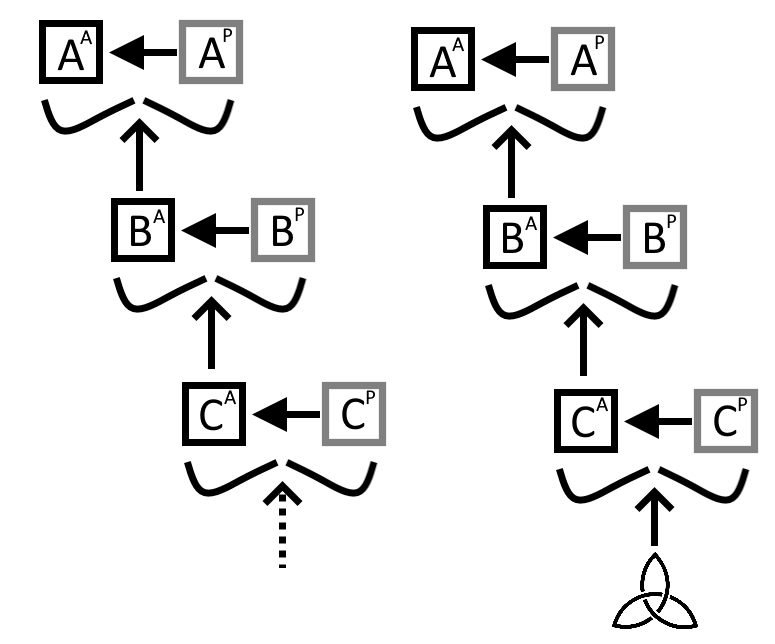
I’ve tried illustrating this with these two images. In the first, we see that the chain continues indefinitely. In the second, there is an unmoved source of movement. As change needs there to be something already there to make the change happen, the movement we observe around us cannot be based on an infinite number of changing things. There must therefore be something which moves others without being moved itself.
And this, as Aquinas says, everyone understands to be God.
The Argument in the Summa Contra Gentiles
The argument is presented in a much more extended form in the Summa Contra Gentiles book 1 chapter 13, where Aquinas states the proofs which Aristotle provides for:
That everything that moves is moved by another.
There cannot be an infinite number of movers.
I would like to write a detailed commentary on this chapter, however it would take much more time due to the length of the chapter. If you would like to read it for yourself it is online for free here.
From Unmoved Mover to God
Some critics say that even if you accept the argument from motion, this only proves that there is some unmoved mover, not that God (in the Christian sense) exists. Yet Aquinas never stops with the Unmoved Mover. In the Summa Theologiae he goes on to argue that this thing must be simple, perfect, good, infinite, omnipresent, immutable and eternal. He argues that God must have knowledge, will, love, justice and mercy. He argues that God is all powerful and that he is perfectly happy.
The entirety of the Summa Contra Gentiles is based on the argument from motion. As Aquinas does not use the authority of Scripture until Book 4 (out of 4 books). Based on the Unmoved Mover Aquinas argues to God’s simplicity, perfection, goodness, infinity, intelligence, understanding, will, love, happiness, and power.
In fact, while writing this article I initially thought this is what he was doing, and had to figure out how I’d never noticed this before!